Part of the free Module 5: Excel Formulas and Functions · Function 84 of 105 · Full Excel course
The Excel TEXT function converts a number, date or time into a text string displayed in the format you specify, such as “dd-mmm-yyyy”, “#,##0.00” or “0%”. It returns text, so the value can be joined with other words in a sentence, used as a label or exported with a fixed appearance. TEXT is the function to reach for whenever a date or amount inside a formula shows up as a plain serial number.
Syntax
=TEXT(value, format_text)Arguments
| Argument | Required / Optional | Meaning |
|---|---|---|
| value | Required | The number, date, time or cell reference to format. |
| format_text | Required | A number format code in double quotes, using the same codes as Format Cells > Custom, for example “0.00”, “dd/mm/yyyy” or “h:mm AM/PM”. |
Useful format codes
The table below lists the format codes used most often with TEXT. Any code that works in the Custom number format dialog also works here.
| Format Type | Details |
|---|---|
| 0 | Forces the display of a digit in its place |
| # | Display digit if it adds to the accuracy of the number (but don't display if a leading zero or a zero at the end of a decimal) |
| . | Defines the position that the decimal place takes |
| d | Day of the month or day of week |
| d = one or two digit representation (e.g. 1, 12) | |
| dd = 2 digit representation (e.g. 01, 12) | |
| ddd = abbreviated day of week (e.g. Mon, Tue) | |
| dddd = full name of day of week (e.g. Monday, Tuesday) | |
| m | Month (when used as part of a date) |
| m = one or two digit representation (e.g. 1, 12) | |
| mm = two digit representation (e.g. 01, 12) | |
| mmm = abbreviated month name (e.g. Jan, Dec) | |
| mmmm = full name of month (e.g. January, December) | |
| y | Year |
| yy = 2-digit representation of year(e.g. 99, 08) | |
| yyyy = 4-digit representation of year(e.g. 1999, 2008) | |
| h | Hour |
| h = one or two digit representation (e.g. 1, 20) | |
| h = two digit representation (e.g. 01, 20) | |
| m | Minute (when used as a part of a time) |
| m = one or two digit representation (e.g. 1, 55) | |
| m = two digit representation (e.g. 01, 55) | |
| s | Second |
| s = one or two digit representation (e.g. 1, 45) | |
| ss = two digit representation (e.g. 01, 45) | |
| AM/PM | Indicates that a time should be represented using a 12-hour clock, followed by "AM" or "PM" |
Key points: 0 forces a digit, # shows a digit only if present, , adds a thousands separator, % multiplies by 100, and the letters d, m, y, h, s build date and time patterns. Because “m” means month, use “mm” inside a time only after “h” so Excel reads it as minutes.
Step-by-step example
The screenshot shows TEXT applied to the same value with different format codes.
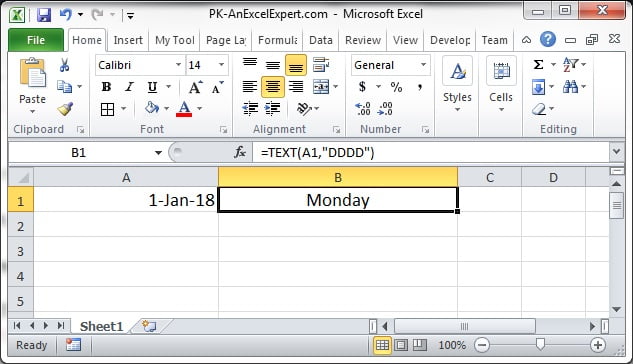
- Enter a date in A2 (for example 4 September 2026) and a number such as 1234.5 in A3.
- In B2 enter
=TEXT(A2,"dd-mmm-yyyy"). The result is04-Sep-2026. - In C2 enter
=TEXT(A2,"dddd"). The result isFriday. - In B3 enter
=TEXT(A3,"#,##0.00"). The result is1,234.50. - In C3 enter
=TEXT(A3,"$#,##0"). The result is$1,235. All results are text and align left.
Practical use cases
1. Dates inside a sentence
="Report generated on "&TEXT(TODAY(),"dd mmmm yyyy")2. Leading zeros for codes
=TEXT(A2,"00000")Turns 42 into 00042, keeping the zeros when the sheet is exported to CSV.
3. Percentages and currency in labels
="Margin: "&TEXT(B2,"0.0%")&" on "&TEXT(C2,"₹#,##0")4. Month and year grouping key
=TEXT(A2,"yyyy-mm")Creates a sortable key such as 2026-09 for PivotTables and SUMIFS.
5. Elapsed time over 24 hours
=TEXT(B2-A2,"[h]:mm")The square brackets stop hours rolling over at 24.
Common mistakes and tips
- Result cannot be summed: TEXT returns text. Keep the raw values numeric and apply TEXT only for display or concatenation.
- Locale differences: format codes follow the Excel display language. On a German system, “dd.mm.jjjj” is needed instead of “dd.mm.yyyy”.
- #VALUE! error: the format code contains an unsupported character, or the value is text that cannot be interpreted.
- Minutes vs months: “mm” alone means month. Write “h:mm” or “mm:ss” so Excel treats it as minutes.
- Just changing appearance? Use Format Cells instead; TEXT is for when the formatted value must become part of a text string.
TEXT compared with number formatting, DOLLAR and FIXED
Cell formatting changes how a number looks while leaving it numeric, which is what you want for tables, charts and totals. TEXT produces a text copy in a chosen format, which is what you want inside sentences, labels, lookup keys and exports. DOLLAR and FIXED are special cases of TEXT with preset formats: DOLLAR(A2) equals TEXT(A2,”$#,##0.00″) on a US system and FIXED(A2,2) equals TEXT(A2,”#,##0.00″). TEXT is more flexible because it accepts any custom code, including conditional sections such as "[Green]0;[Red]-0" and text literals in quotes. To reverse the operation and turn formatted text back into a number, use VALUE or DATEVALUE.
Related functions
- VALUE: converts formatted text back to a number.
- DOLLAR: a preset currency version of TEXT.
- FIXED: a preset decimal version of TEXT.
- CONCAT: joins TEXT results with other strings.
- See all lessons in the Excel Formulas course.
Frequently asked questions
How do I convert a date to text in Excel?
Use =TEXT(A2,”dd-mm-yyyy”) or any other date code. The result is a text string that keeps the chosen format when joined with other text.
Why does my TEXT formula show the wrong month or minutes?
The code “mm” means month unless it follows an hour code. Write “h:mm” for hours and minutes and “dd/mm/yyyy” for dates.
Can I convert the TEXT result back to a number?
Yes. Wrap it in VALUE for numbers, or DATEVALUE and TIMEVALUE for dates and times.
Need a ready-made template? Browse 7,000+ Excel, Power BI and Google Sheets templates at NextGenTemplates.com.